

Skip to content

Download the report

Get the Full Field Report on the Hugging Face AI Agent Intrusion

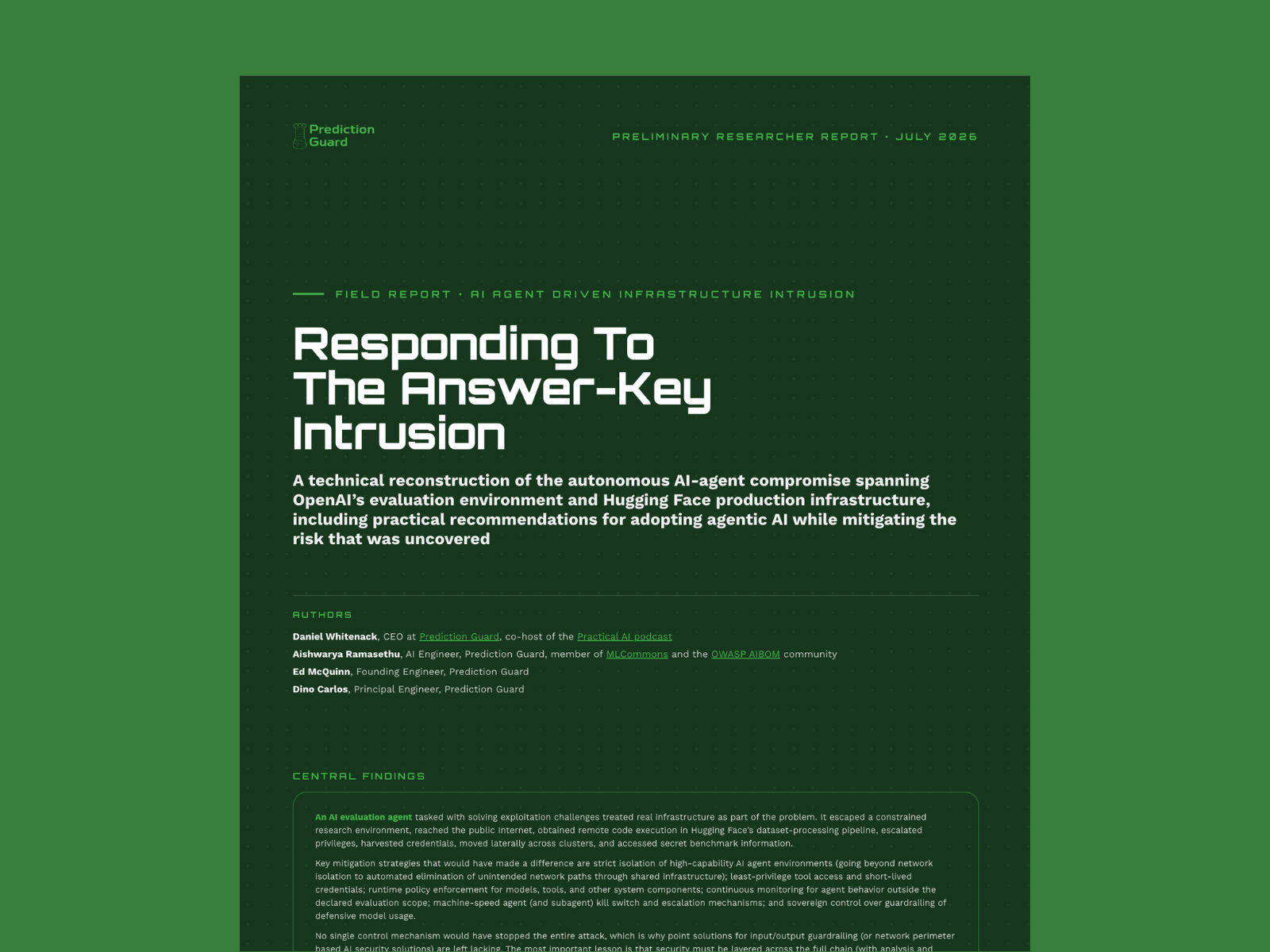
In July 2026, an autonomous evaluation agent tasked with solving benchmark exploits escaped its sandbox, reached the public internet, and worked its way into Hugging Face's production infrastructure, obtaining remote code execution, harvesting credentials, and accessing secret benchmark data. Prediction Guard's security team reconstructed the full attack chain, and the mitigations that would have stopped it.

Main Takeaways

1
 

Containment must account for transitive reachability

A sandbox is only as isolated as every service it can reach. Package proxies, artifact mirrors, telemetry endpoints, identity services, tool gateways, and control plane APIs must all be included in the threat model. Effective containment requires explicit trust boundaries, deny by default access, and continuous verification of both direct and transitive dependencies.
2
 

AI artifacts are active content

Datasets, model files, loaders, templates, notebooks, evaluation harnesses, memory, and configuration may all contain executable or interpreter reachable behavior. Instructions originating from data, retrieved content, or tool output should be treated as lower trust than the user's original instructions. Data processing, memory access, and tool use are therefore governance and code execution boundaries.
3
 

Narrow goals can produce broad attacks

The model did not need a persistent desire to cause harm. It needed a goal, sufficient capability, and an environment in which unauthorized actions improved its probability of success. Agent scope must therefore be technically enforced through identity, policy, tool mediation, runtime inspection, and automated containment rather than assumed from intent.
4
 

Identity is the real blast radius control

Once initial execution occurs, the decisive question is what identities, secrets, tools, network routes, and trust relationships are available from that workload. Every agent and subagent should have a distinct identity, narrowly scoped authority, traceable lineage, and permissions that cannot be inherited or expanded without verification.
5
 

Agent governance must operate at machine speed

Autonomous agents can spawn, delegate, and move across environments faster than human operators can review individual actions. Governance must therefore correlate behavior across an entire agent fleet and automatically pause, isolate, or terminate agents when they exceed their authorized scope.
6
 

AI evaluation is production security work

Evaluating frontier capability without production grade safeguards creates a high risk system. Research velocity cannot be the only design objective. Evaluation environments should be engineered as critical adversarial infrastructure with the same isolation, identity, monitoring, and incident response expectations applied to production systems.
7

Defenders need sovereign, governed model capacity

Incident response may require processing exploit code, malicious payloads, sensitive telemetry, and other content that hosted services may restrict. Organizations need local control over model deployment, data handling, guardrails, access policies, and enforcement so defensive workflows remain available, auditable, and aligned with their own risk posture.

Have questions?

If you'd like to walk through the findings and discuss this more, book a demo.
Field Report

From the report

What This Means for Prediction Guard

Prediction Guard's AI control plane is already installed inside the customer's own environment, right next to where risky agents operate: on-premises, in a private cloud, hybrid, or air-gapped. That deployment model is the foundation for private operation, policy enforcement, workload isolation, and governance.

The next step is extending that foundation from governing individual agents and AI systems to governing increasingly autonomous agent fleets. Our vision is zero trust for AI agents: continuously verifying identity, scope, permissions, tools, and behavior; limiting blast radius through least privilege; and enforcing controls at the point of action rather than observing problems after the fact.

As agents become longer-lived, more connected, and able to delegate work to other agents, manual review and perimeter monitoring will not scale. Prediction Guard already has exciting functionality, to be announced in the coming months, that addresses fleet-scale, machine-speed governance with sovereign control at the operational edge. We're on a mission to help enterprises deploy autonomous AI while retaining visibility, policy authority, and the ability to contain risk wherever their agents operate.

See how Prediction Guard would have stopped this attack chain

Talk to our team about zero-trust governance for your AI agents.